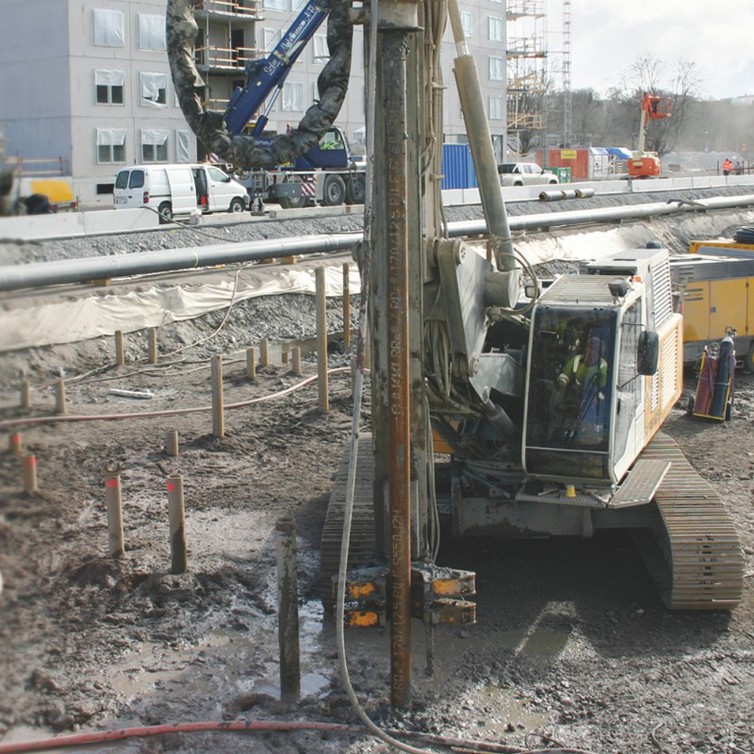
The DTH Hammer drilling at the end of the drill string is the main component in down-the-hole drilling (DTH). Air, rotation, and bit loading (weight) are the three components that it uses to drill holes with. Rock may be crushed effectively using this combination of active ingredients. DTH Hammer drilling strikes are regularly applied to the rock while the drill string slowly spins. Compressed air drives an internal piston in the hammer, giving it striking power.
DTH (Down-The-Hole) hammer drilling is commonly used in mining, quarrying, construction, water well drilling, geothermal drilling, and civil engineering projects. It is employed for tasks such as blast hole drilling, rock extraction, foundation drilling, pile drilling, geotechnical investigations, water well drilling, geothermal energy extraction, tunneling, and dam construction. DTH hammer drilling is favored for its ability to efficiently penetrate hard rock formations and achieve high drilling rates, making it a preferred technique in applications that require productive and effective drilling in challenging geological conditions.
For bigger, deeper holes in medium-hard rocks, DTH Hammer drilling has a number of advantages over top-hammer drilling. Power loss as the hole deepens is negligible because the DTH Drill Hammer is near the bottom of the hole. As long as back pressure inside the borehole doesn't dramatically increase, this means that energy isn't lost in the drill string and penetration rates don't significantly decrease with depth. With a few exceptions, DTH Hammer drilling is best suited for holes with a diameter of 4 to 10 inches.
Suitable for Deep Drilling: DTH hammer drilling is well-suited for deep drilling applications. Its efficient penetration and high drilling rates make it effective in reaching greater depths, such as in water well drilling or geothermal drilling projects.